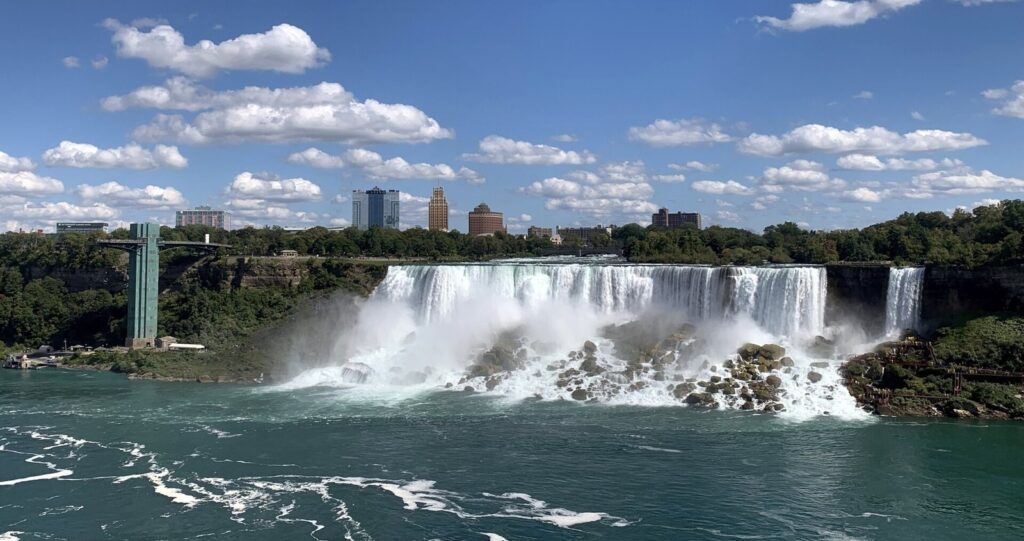
Seeing Niagara Falls from Buffalo NY takes less effort than most people expect. Niagara Falls State Park sits about 20 miles north of downtown Buffalo: 25 to 35 minutes by car up the I-190, or about an hour on NFTA’s Route 40 bus for a $2 fare. The park is free to walk into, so the real decisions are how you get there, where you leave the car, whether you cross the Rainbow Bridge to the Canadian side, and how much of your trip you hand over to the falls.
This guide is for anyone using Buffalo as a base: a weekend visitor, a business traveler with a spare afternoon, a family, or someone landing at Buffalo Niagara International Airport. The caveat that matters most is the border. The US side needs nothing more than a ride. The Canadian side, with the head-on view of all three falls, needs a passport or another accepted document and turns a half day into a full one. Fares, parking fees, hours and seasons below were checked September 23, 2026 against official sources.
Niagara Falls from Buffalo at a Glance
The short answers first. Each row gets its own section further down.
| Question | Short answer |
|---|---|
| How far is it? | About 20 miles from downtown Buffalo to Niagara Falls State Park |
| Fastest way | Driving: 25–35 minutes on the I-190 outside rush hour |
| Cheapest way | NFTA Route 40 bus: $2 a ride, about an hour each way |
| What entry costs | Nothing on foot. Cars pay in the state lots: $10–$15 in Lots 1 and 2 through October 11, then $10 a day; Lot 3 is free daily until May 21 and Lot 4 has no fee |
| Time needed | 3–4 hours for the US side; a full day if you add the Canadian side |
| Best time | Weekday mornings; September and October for smaller crowds while the boats still run |
| Book ahead? | Rarely. Maid of the Mist sells tickets on the day; book tours and summer-weekend hotels |
| Passport? | Only if you cross into Canada |
How Far Is Niagara Falls from Buffalo?
The falls aren’t in Buffalo, and you can’t see them from the city. They’re in the separate City of Niagara Falls, in Niagara County, about 20 miles downstream on the Niagara River. The river starts at Buffalo’s own waterfront, where Lake Erie drains out past the Peace Bridge, then runs north around Grand Island, drops over the falls and cuts through a gorge to Lake Ontario. Stand on the observation deck on the 28th floor of Buffalo City Hall and you’re looking at the same water, about 20 river miles before it goes over the edge.
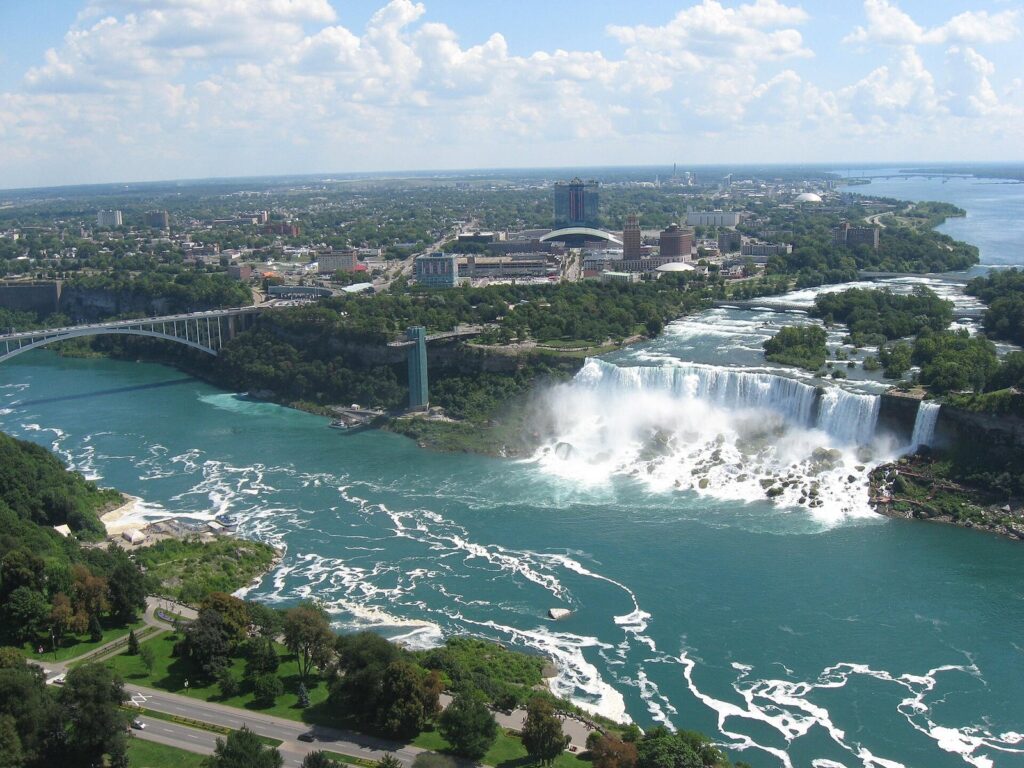
The name causes most of the confusion. Niagara Falls is three waterfalls (the American Falls, the narrow Bridal Veil Falls beside it, and the far larger Horseshoe Falls), two cities facing each other across the gorge (Niagara Falls, New York, and Niagara Falls, Ontario), and two park systems: Niagara Falls State Park on the US side and the Niagara Parks lands, including Queen Victoria Park, in Canada. When someone in Buffalo says they’re going to the falls, they almost always mean the state park. It’s the oldest state park in the country, set aside in 1885 and laid out by Frederick Law Olmsted and Calvert Vaux, the same pair who designed Buffalo’s park system.
Distance, then, is not the problem. Rush hour on the I-190 and summer weekend traffic into the park can add 15 minutes or more to the drive, but what really eats the day is everything after you arrive: parking, the boat line and, if you cross, the border.
If Buffalo itself is new to you, our guide to the best things to do in Buffalo shows which city sights to schedule around the falls. Several keep weekday-only or closed-midweek hours; the falls never close.
What Are the Ways to Get from Buffalo to Niagara Falls?
There are six realistic ways to make the trip, and two of them cover most visitors: a car, or NFTA’s Route 40 bus. The rest suit particular situations. Times below run from downtown Buffalo to the edge of the falls, and costs are for one adult, one way.
| Option | Door to falls | Cost | Best for | The catch |
|---|---|---|---|---|
| Car | 25–35 min | Gas, plus $0–$15 to park | Families, the Canadian side, add-on stops | Summer weekend traffic and parking fees |
| NFTA Route 40 bus | About 1 hr, plus a 10–15 min walk | $2, or $5 for a day pass | Solo travelers and couples on a budget | Slow; plan the ride back before you go |
| Amtrak | Short ride, plus about 2 miles to the falls | Varies by train and date | Travelers continuing to Toronto or New York City | Only a few trains a day |
| Guided tour | Hotel pickup | The most expensive option | First-timers without a car on a short stay | Fixed schedule; Canadian stops need passports |
| Rideshare or taxi | 25–35 min | Depends on demand | Groups splitting a fare, late returns | Surge pricing on busy evenings |
| Bike | Half a day of riding | Free | Strong cyclists | About 25 miles each way; no bikes on the Grand Island bridges |
Driving from Buffalo to Niagara Falls
Driving is the default for a reason. The route is simple: north on the I-190 from downtown, over the South Grand Island Bridge, straight across Grand Island, over the North Grand Island Bridge, then along the upper river into the City of Niagara Falls. Any map app will take you to the state park lots without drama. The whole run is about 20 miles, and outside the morning and evening rush it takes 25 to 35 minutes.
The car wins in four situations. You’re traveling with kids or with anyone who can’t walk far. You want to add the Niagara Gorge parks or push on to Lewiston. You want to cross into Canada on your own schedule. Or you’d like to be back in Buffalo for dinner without watching a bus timetable. It loses on a summer Saturday, when the main lots charge their top rate and the approach roads back up.
In a rental, check that the contract allows Canada before you head for the border. Longer drives around the region, from Lewiston and Old Fort Niagara to the Niagara Wine Trail, belong in our day trips from Buffalo guide.
Plan it: about 20 miles and 25–35 minutes each way from downtown. The park is free, but its state lots charge a vehicle use fee: Lots 1 and 2 cost $10 Monday to Thursday and $15 Friday to Sunday through October 11, then $10 a day from October 12 through March 31; Lot 3 is free daily until May 21, and Lot 4 has no fee. On summer weekends, aim to park before 10 a.m.
Taking the NFTA Route 40 bus
The cheapest way from Buffalo to Niagara Falls is NFTA Metro’s Route 40, which runs seven days a week from the Metropolitan Transportation Center in downtown Buffalo through Black Rock, over Grand Island and into downtown Niagara Falls, finishing at the Portage Road Transit Center. A ride costs $2, children under 10 ride free, and a Day Pass costs $5. With a MetGo card, fares cap at $5 a day, so you never pay more than a day pass however many times you board. You can pay cash on the bus, but cash rides don’t count toward the cap.
The trip takes about an hour, and the timetable gives you the scale: the first weekday bus leaves Portage Road at 5:20 a.m. and reaches the Metro Center at 6:23 a.m. The Seneca Niagara Casino is one of the route’s timepoints and a sensible place to get off, because the park is roughly half a mile west of it, 10 to 15 minutes on foot. NFTA’s trip planner will confirm the nearest stop for your direction of travel.
The bus is the right call for a solo traveler or a couple staying downtown who want the US side and nothing more. It’s the wrong call with small children or with Canada on the list: an hour each way, plus the walk and a border crossing, leaves a thin day. Our stop-by-stop guide to the Buffalo to Niagara Falls bus, Route 40, covers where to board, where to get off and how to time the return, and our guide to getting around Buffalo explains the fares, passes and the Metro Rail for the rest of your stay.
Plan it: $2 a ride or $5 for a day pass, with children under 10 free; about an hour each way; board at the Metropolitan Transportation Center on Ellicott Street; check return times on NFTA’s Route 40 page before you leave.
Taking the train
Amtrak serves a Niagara Falls, New York, station near the Whirlpool Rapids Bridge, about two miles north of the falls, and trains between New York City and Toronto stop in the Buffalo area on the way. It sounds tidy. In practice there are only a few trains a day, timed for long-distance passengers, and you still need a taxi or a 40-minute walk from the station to the park. The train earns its place when the falls are one stop on a longer rail journey; for a day trip from Buffalo, it rarely beats the bus.
Guided tours from Buffalo
Plenty of companies run small-group Niagara Falls tours with pickups at Buffalo hotels. Some stay on the US side and some cross into Canada. A good tour handles the parking, the boat tickets and the timing, and a decent guide fills in the hydropower and daredevil stories you’d otherwise miss. A weak one spends half the day in a van. Before you book, ask how many hours you’ll actually spend at the falls, whether the Maid of the Mist or Cave of the Winds is included, what replaces the boat once it stops for the season, and, for two-country tours, exactly which documents everyone needs.
Tours make sense for first-timers without a car and for travelers with one free day who want both sides handled. For a couple with a rental car and no plans to cross the border, a tour costs far more than the same day on your own. Book a day or more ahead in summer.
Rideshare, taxis and bikes
Rideshare and cabs take the same 25 to 35 minutes as driving, at fares that rise with demand, so they work best one way: bus up in the afternoon, stay for the lights, ride back. Cyclists can’t use the interstate bridges over Grand Island and follow the mainland shore through the Tonawandas instead, roughly 25 miles each way.
Two situations get guides of their own. If you don’t have a car at all, our guide to getting from Buffalo to Niagara Falls without a car ranks the bus, train, tours and rideshare on cost, time and comfort. If you’re flying in, getting from Buffalo airport to Niagara Falls without a car takes a transfer, and that guide walks you through it. None of the NFTA routes that serve the airport, the 24 Genesee, the 24L and the 78 express, goes anywhere near the falls.
Where Should You Park at Niagara Falls State Park?
The state park doesn’t charge admission. Walk in from downtown Niagara Falls, step off the bus or cycle in, and you pay nothing. What you pay for is the car. The park’s lots charge a vehicle use fee, and the rate depends on the lot, the day of the week and the season.
| State lot | Now through October 11, 2026 | October 12, 2026 to March 31, 2027 |
|---|---|---|
| Lots 1 and 2 | $10 Monday to Thursday; $15 Friday to Sunday | $10 daily |
| Lot 3 | Free daily (free Tuesday to Thursday all year) | Free daily through May 21 |
| Lot 4 | No fee | No fee |
In fall and winter the question almost answers itself, with Lot 3 free daily and Lot 4 free always. In summer the premium lands on Friday through Sunday, so if your schedule bends, a Tuesday-to-Thursday visit gets you a free spot in Lot 3 even in July.
Private lots in downtown Niagara Falls compete for your car too. Their prices vary, so compare the posted rate with the state lots before you turn in. The park’s official parking page has the current rates and a map, and our Niagara Falls State Park parking guide for Buffalo visitors matches each lot to the sights it serves and covers what to do when they fill on holiday weekends.
US Side or Canadian Side: Which Should You See from Buffalo?
This is the decision that shapes the whole day. The US side puts you beside and above the water; the Canadian side gives you the view from the postcards, at about the same distance from Buffalo plus a border crossing each way.
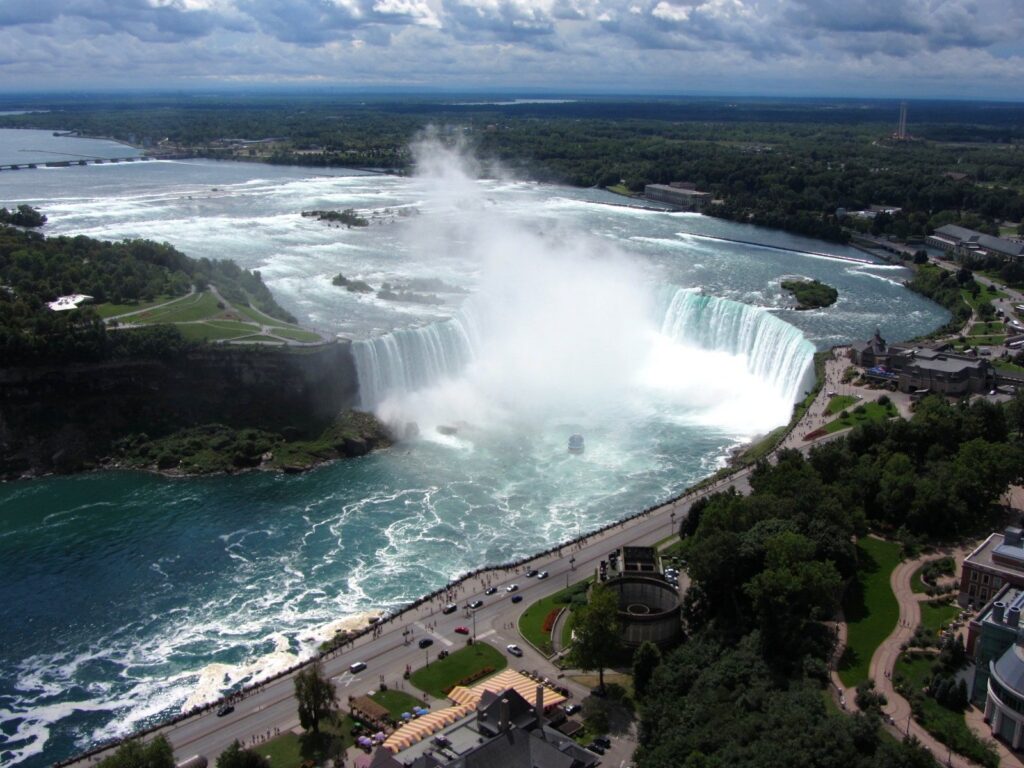
On the US side, Niagara Falls State Park lets you stand at the brink. Prospect Point puts you at the edge of the American Falls, close enough to watch the water curl over. Goat Island splits the river between the two main falls. From Terrapin Point, at its tip, the Horseshoe Falls drops away beside you, and the Three Sisters Islands, linked by footbridges, put you in the middle of the upper rapids. The Cave of the Winds walkways reach the base of the Bridal Veil Falls. What you can’t get from the US side is the full frontal view. The Horseshoe Falls, the largest of the three, curves toward Canada, and from New York you see the American Falls mostly from the side.
On the Canadian side, the Niagara Parkway runs along the rim facing both falls, and Queen Victoria Park gives you the panorama that fills calendars and screensavers. Most of the Horseshoe Falls lies in Canada, and at Table Rock you stand almost at its edge. The trade-off is the setting: behind the parkland rise casino towers, hotels and the arcades of Clifton Hill. Some visitors love the neon. Others find it a strange frame for a natural wonder.
| US side | Canadian side | |
|---|---|---|
| The view | Up close: the brink, the rapids, the base of the falls | Head-on panorama of all three falls |
| From Buffalo | About 20 miles, no border | Similar distance, plus a border crossing each way |
| Documents | Nothing special | Passport, passport card, NEXUS card or enhanced driver’s license for US citizens |
| Boat | Maid of the Mist | Niagara City Cruises |
| Setting | Olmsted parkland, quiet after dark | Parkland backed by hotels, casinos and Clifton Hill |
| Money | US dollars | Canadian dollars; cards work almost everywhere |
Our verdict: if everyone in your group has a passport or passport card and you can give the falls a full day, see both. Do the US side in the morning, walk across the Rainbow Bridge around lunchtime, take in the panorama from the Canadian rim, and walk back after dinner once the lights come on. If anyone lacks documents, or you only have half a day, the US side alone is a complete trip, and it’s the side where you feel the spray on your face. Our attraction-by-attraction comparison of Niagara Falls, US side vs Canada side from Buffalo, goes deeper on views, prices and crowds.
What Do You Need to Cross the Border at Niagara Falls?
The crossing itself is routine, but it’s an international border with federal rules on both ends. US citizens returning by land need a document that meets the Western Hemisphere Travel Initiative: a passport, a passport card, a NEXUS card or an enhanced driver’s license. An ordinary driver’s license won’t do. Visitors who aren’t US citizens need a passport plus whatever visa or authorization their nationality requires for Canada and for getting back into the United States. Check both governments’ rules before you go, because permission to be in the US doesn’t cover Canada. If you’re traveling with children, bring their documents too, and carry a letter of consent if only one parent is along.
From Buffalo you have three practical crossings:
- The Peace Bridge leaves Buffalo’s West Side for Fort Erie, Ontario. From there the Niagara Parkway follows the river north to the falls, a slow and pretty drive of about half an hour, or the QEW gets you there faster. Budget 35 to 45 minutes from downtown Buffalo, plus the border line.
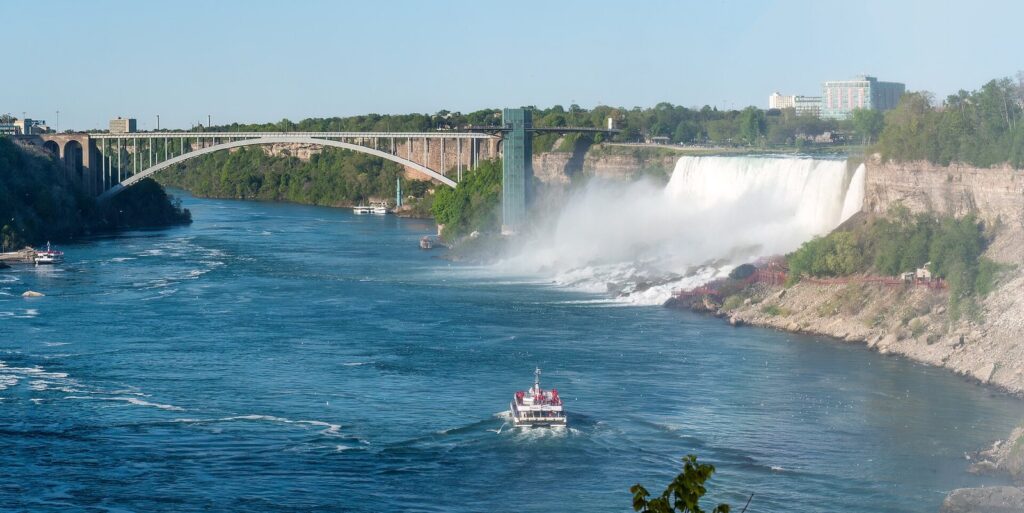
- The Rainbow Bridge crosses the gorge just below the American Falls and lands you minutes from the Canadian viewpoints. Drive up to Niagara Falls, New York, first, or park on the US side and walk across; the walk takes about 10 minutes, plus the customs line. Cars pay a toll and walkers pay a smaller one; the Niagara Falls Bridge Commission posts current amounts.
- The Lewiston-Queenston Bridge, a few miles north near Lewiston, is sometimes the quicker choice when the Rainbow Bridge backs up.
The Whirlpool Rapids Bridge, between the other two, is open only to NEXUS members. Cannabis is legal in both New York and Ontario, but carrying it across the border in either direction is not. Declare what you bought in Canada on the way back, and check the live wait times both countries publish: a few minutes on a weekday morning can become a long crawl on summer weekends.
How Long Should You Spend at Niagara Falls?
Half a day covers the US side properly. A full day covers both sides without rushing. Add the round trip from Buffalo on top: about an hour in total by car, two hours or more by bus.
| Time at the falls | What fits | What to skip |
|---|---|---|
| 2–3 hours | Prospect Point, then the Goat Island walk to Terrapin Point and the Three Sisters Islands | Boats, Canada, the gorge |
| Half day (4–5 hours) | All of the above, plus the Maid of the Mist or Cave of the Winds and lunch | Canada |
| Full day | US side in the morning, the Rainbow Bridge walk, the Canadian panorama, dinner and the lights | Nothing essential |
| Overnight | Sunrise at the brink, the gorge trails, Lewiston | Nothing |
The two-hour version works because the US park is compact and mostly flat: Prospect Point, then Goat Island, Terrapin Point and the Three Sisters, and you’ve seen all three falls from above. The boat is what doesn’t fit.
Our guide to how long to spend at Niagara Falls from Buffalo builds each of these budgets in more detail. For the day itself, the plan for one day at Niagara Falls State Park puts the US side in order stop by stop, and the complete Niagara Falls day trip from Buffalo covers the whole thing from breakfast to the drive home. If the falls are one day of a longer visit, our Buffalo itineraries show where they fit in a two-, three- or four-day stay.
What Is There to Do on the US Side?
This is the short list. Everything below sits inside Niagara Falls State Park or within a few miles of it, and most of it is free.
Prospect Point and the Observation Tower
Prospect Point is the railing at the brink of the American Falls, a few minutes’ walk from downtown Niagara Falls and the obvious first stop. The Observation Tower beside it juts out over the gorge for a side view of the American and Bridal Veil Falls with the Horseshoe beyond, and its elevator carries Maid of the Mist passengers down to the dock at the bottom.
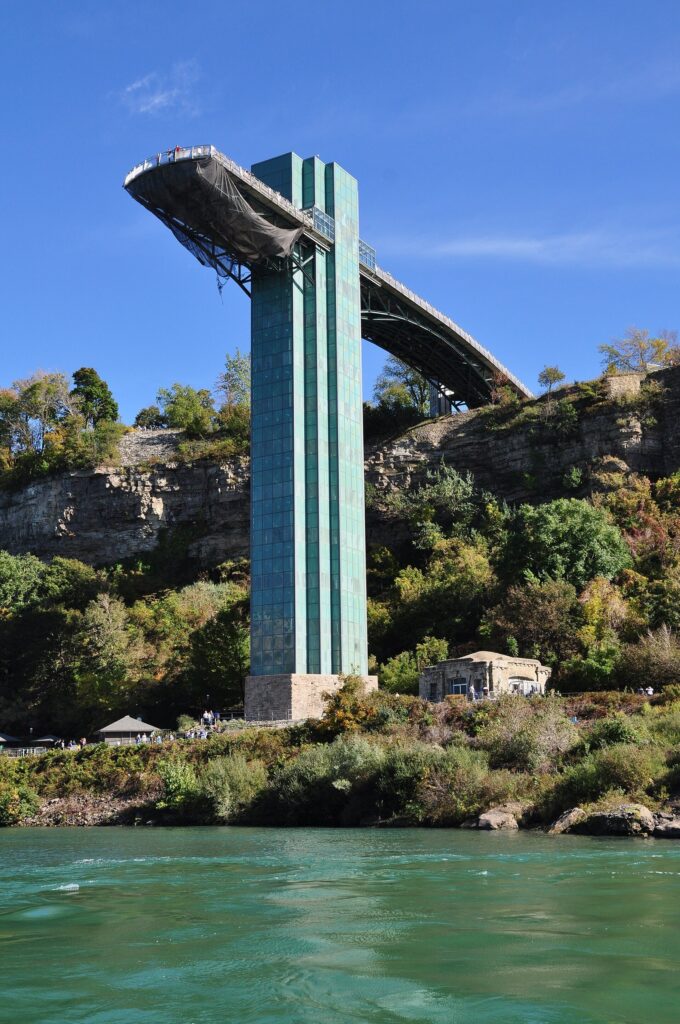
Plan it: the paths are free; the tower elevator is included in Maid of the Mist tickets; allow 30 minutes.
Goat Island, Terrapin Point and the Three Sisters Islands
Goat Island sits between the American and Horseshoe Falls, reached by a road bridge with a sidewalk from the mainland. Terrapin Point, at the end facing Canada, is the closest you can get to the Horseshoe Falls on the US side. Along the island’s upstream shore, small footbridges lead out to the Three Sisters Islands, where the upper rapids tear past a few feet away. It’s the most underrated corner of the park, and usually the quietest.
Plan it: free; the loop from Prospect Point out to Terrapin Point and the Three Sisters and back takes 1–1.5 hours at a stroll; the main paths are paved and mostly level.
Maid of the Mist
The Maid of the Mist has taken passengers into the spray since the 19th century, and the boat ride is still the most direct way to feel what all that water weighs. You board at the foot of the Observation Tower, pull on a poncho, and the boat noses past the American Falls into the churning basin of the Horseshoe. You will get wet. Your shoes will get wet. Nobody has ever regretted bringing a dry shirt.
Plan it: $30.25 for adults, $19.75 for ages 6–12, free for 5 and under with a paying adult; open 9 a.m.–5 p.m. weekdays and 9 a.m.–6 p.m. weekends through September 27, then daily 9 a.m.–5 p.m. until the 2026 season ends on November 8; tickets online or at the ticket office on the day, with the tower elevator included; allow about an hour. See the operator’s schedule and prices.
Cave of the Winds
Cave of the Winds takes you by elevator down into the gorge and along wooden walkways to the foot of the Bridal Veil Falls. The top level, the Hurricane Deck, sits close enough to the falling water to feel like standing in a storm. The decks are taken down each fall and rebuilt each spring, because winter ice would wreck them, so the full experience is seasonal. The attraction hands out sandals and a poncho, and you’ll need both.
Plan it: ticketed, with hours and prices that change through the year; check the park’s Cave of the Winds page on the day; allow about an hour, more on summer afternoons.
The Niagara Gorge
Downstream of the falls, the river races through a gorge about seven miles long, and New York state parks line the US rim. Whirlpool State Park looks down on the Niagara Whirlpool, where the river swings through a sharp bend, and Devil’s Hole State Park has a stone stairway down toward the rapids. Trails run along the rim and, for the fit, down to the water’s edge. Most visitors never see this part, which is reason enough to go.
Plan it: free; a car helps, since the parks sit a few miles north of the falls; allow 1–3 hours; the lower trails are steep, rocky and slick after rain.
When Is the Best Time to Visit Niagara Falls from Buffalo?
The falls run all year, but what you can do there changes with the season more than most people expect.
| Season | What’s running | Crowds | Parking | Verdict |
|---|---|---|---|---|
| Summer (late May to Labor Day) | Everything, including both boats and the full Cave of the Winds | Heaviest, especially Friday to Sunday | $15 Friday to Sunday in Lots 1 and 2 | Best for first-timers who want it all |
| Fall (September to early November) | Maid of the Mist through November 8, 2026 | Moderate, light midweek | $10 a day from October 12; Lot 3 free | The sweet spot |
| Winter (mid-November to March) | The park and the nightly lights; no boats | Light | $10 in Lots 1 and 2; Lot 3 free | Ice scenery, if you dress for it |
| Spring (April and May) | Maid of the Mist from late April (April 24 in 2026) | Light until Memorial Day | Lot 3 free daily until May 21 | Good, if cold and damp |
Fall is the sweet spot for a trip from Buffalo. The summer crowds thin after Labor Day, the Maid of the Mist keeps sailing daily from 9 a.m. to 5 p.m. through November 8, parking drops to $10 a day from October 12, and Lot 3 costs nothing. Bring a layer for the colder spray, and start early: by the end of October the sun sets a little after 6 p.m.
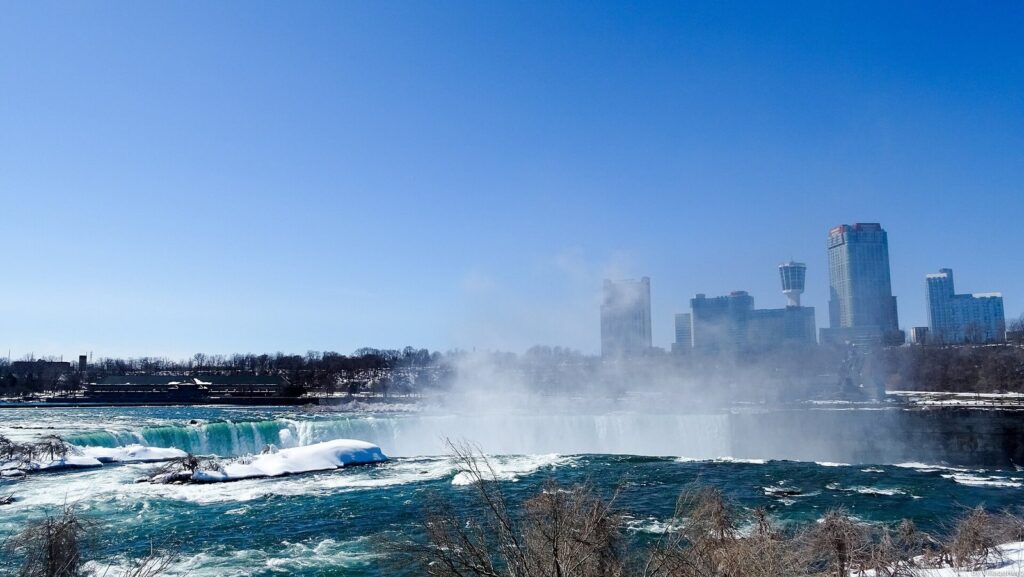
Winter is for people who like ice. The boats stop, the Hurricane Deck comes down, and spray freezes onto every tree and railing near the brink. The park stays open and the falls are lit every night. Snow is a bigger question in Buffalo than at the falls: lake-effect bands usually hit the Southtowns hardest, but a bad one can snarl the I-190 too. Our guide to Niagara Falls in winter from Buffalo covers what’s open, what to wear and how to judge the drive.
One quirk applies all year. A 1950 treaty between the United States and Canada lets both countries divert water around the falls to their hydroelectric plants, but it guarantees a larger minimum flow over the falls in daytime during the tourist season, April through October, than at night or in winter. So the falls carry noticeably less water after dark and in the off-season.
Should You Stay in Buffalo or in Niagara Falls?
For most visitors, Buffalo is the better base and the falls are the day trip. Buffalo has the restaurants, the museums, the architecture, the sports teams and a wider spread of hotels, and it’s only half an hour from the park. Staying in Niagara Falls, New York, makes sense for one reason: you can walk to the brink at night and at sunrise without driving. The blocks near the park have hotels and the casino, but far fewer places to eat than Buffalo.
The Canadian side is a resort town with hotels overlooking the falls; if the falls are the point of your trip, a night there for the view can be worth the crossing. Rates on both sides peak on summer weekends. Our guide to whether you should stay in Buffalo or Niagara Falls NY for a trip weighs the trade-offs, and our Buffalo where-to-stay guide sorts the city’s neighborhoods and hotel types.
Visiting with Kids or After Dark
Kids take to the falls easily. The main paths are paved, the railings are sturdy, and few things delight a seven-year-old like a poncho and a boat full of spray. Children under 10 ride NFTA buses free and children 5 and under ride the Maid of the Mist free with a paying adult. The real limits are stamina and the walk from the car, so park close and keep the plan short. Our guide to Niagara Falls with kids from Buffalo covers strollers, restrooms, snacks and which attractions suit which ages.
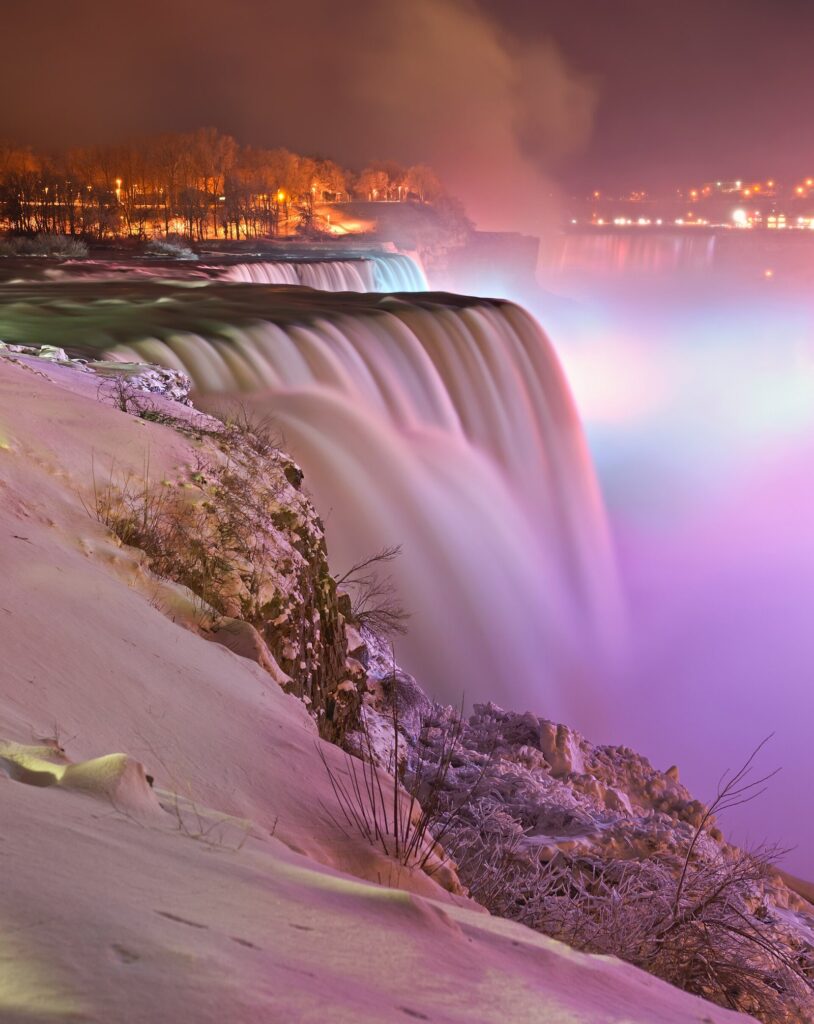
After dark, the falls are lit every night in shifting colors, and the US park feels calmer than it does by day. The lights look best from the Canadian side, where you face them head-on, but Prospect Point and the Goat Island paths still give you the lit water close up. If you’re relying on the bus, check the late departures before you commit to the evening. Our guide to planning an evening trip to Niagara Falls from Buffalo covers timing, the best spots for the lights and getting back.
What Does a Niagara Falls Trip from Buffalo Cost?
Less than you’d think, if you skip the tours. The park is free, the bus is $2, and the only big-ticket item on the US side is the boat. Here’s what a few typical trips cost at fall 2026 prices, before food:
| Trip | What you pay |
|---|---|
| Solo, by bus, US side only | $4 in bus fares |
| Solo, by bus, with the Maid of the Mist | $34.25 |
| Couple, by car, on an October weekday | Gas, $0–$10 to park, and $60.50 for two boat tickets |
| Family of four with two kids aged 6–12, by car, on a Saturday before October 12 | Gas, $15 in Lot 1 or 2 (or nothing in Lot 3), and $100 for four boat tickets |
| Any of the above, plus the Canadian side | Add the bridge toll each way and Canadian attraction prices |
Guided tours cost considerably more than any of these. That’s the price of someone else doing the driving and the tickets, and for some travelers it’s money well spent.
Niagara Falls from Buffalo NY FAQ
How long is the drive from Buffalo to Niagara Falls?
About 25 to 35 minutes from downtown Buffalo to Niagara Falls State Park, a trip of roughly 20 miles on the I-190 across Grand Island. Allow extra time at rush hour and on summer weekends, when traffic into the park slows. From Buffalo Niagara International Airport the drive takes about half an hour. The Canadian side takes longer because of the border crossing.
Is there a bus from Buffalo to Niagara Falls?
Yes. NFTA Metro’s Route 40 runs seven days a week from the Metropolitan Transportation Center in downtown Buffalo to downtown Niagara Falls, then on to the Portage Road Transit Center. The fare is $2, or $5 for a day pass, and children under 10 ride free. The trip takes about an hour. Check the timetable for your return before you leave.
Do I need a passport to see Niagara Falls from Buffalo?
Not for the US side. Niagara Falls State Park is in New York, so there’s no border between Buffalo and the falls. You only need documents if you cross into Canada. US citizens then need a passport, a passport card, a NEXUS card or an enhanced driver’s license to return by land, and other nationalities should check both countries’ entry rules first.
Is Niagara Falls State Park free?
Entry is free for anyone arriving on foot, by bike or by bus. Drivers pay a vehicle use fee in the state lots: $10 Monday to Thursday and $15 Friday to Sunday in Lots 1 and 2 through October 11, 2026, then $10 a day through March. Lot 3 is free every day until May 21, and Lot 4 has no fee. The boat and Cave of the Winds charge separately.
Is the US side or the Canadian side of Niagara Falls better?
They do different jobs. The US side puts you at the brink and beside the rapids, and the Maid of the Mist and Cave of the Winds take you to the base. The Canadian side has the head-on panorama of all three falls. With passports and a full day, see both. With half a day, or without documents, the US side is a complete visit.
Can you see Niagara Falls in half a day from Buffalo?
Yes, if you stick to the US side. With a car, allow about five hours door to door: an hour of driving in total, two to three hours walking Prospect Point, Goat Island and the Three Sisters Islands, and an hour for the Maid of the Mist in season. By bus, allow six hours or more. Adding the Canadian side turns it into a full day.
When does the Maid of the Mist stop running?
The 2026 season ends on Sunday, November 8, and the boats stay docked until the following spring. The season opened on April 24. From September 28 through the close, the boats run daily from 9 a.m. to 5 p.m. Tickets cost $30.25 for adults and $19.75 for children aged 6 to 12, and they include the elevator down to the dock.
Related Buffalo Guides
Sources and How We Checked
Hours, prices, routes and other details in this guide were checked on September 23, 2026 against the official sources below. The guide is compiled from those operators and agencies rather than from other travel lists, and it doesn’t describe first-hand visits. Details change, so confirm anything time-sensitive with the operator before you go.
- Niagara Falls State Park: niagarafallsstatepark.com/park-information/parking
- NFTA Metro: metro.nfta.com/fares/fare-info
- NFTA Route 40: metro.nfta.com/schedules/route/40
- Maid of the Mist: maidofthemist.com/schedule-pricing
- NFTA airport service: metro.nfta.com/getting-around/special-services/airport-se…
- Buffalo City Hall: explorebuffalo.org/downtown/buffalo-city-hall
Buffalo Tourism Guide is an independent publication. We are not affiliated with Visit Buffalo Niagara, the City of Buffalo or any attraction listed here, and no one paid to be included.
Photo Credits
- American Falls and Prospect Point Observation Tower: photo by APK, Wikimedia Commons (CC BY-SA 4.0)
- American Falls and Rainbow Bridge from the Canadian side: photo by Nandaro, Wikimedia Commons (CC BY-SA 3.0)
- Horseshoe Falls and Goat Island: photo by Richie Diesterheft from Santa Barbara, CA, USA, Wikimedia Commons (CC BY-SA 2.0)
- Rainbow Bridge and the American Falls: photo by Rhododendrites, Wikimedia Commons (CC BY-SA 4.0)
- Prospect Point Observation Tower: photo by Don-vip, Wikimedia Commons (CC BY-SA 3.0)
- Horseshoe Falls in winter from Goat Island: photo by VillageHero from Ulm, Germany, Wikimedia Commons (CC BY-SA 2.0)
- American Falls illuminated at night: photo by Paolo Costa Baldi, Wikimedia Commons (CC BY-SA 3.0)